


Why Has My Skin Become More Sensitive During Perimenopause?
- 15 hours ago
- 5 min read
Your skincare has not changed.
The cleanser is the same. The moisturizer is the same. Maybe you have even simplified your routine. Yet suddenly, products that once felt comfortable begin to sting. Your skin feels tighter, drier or less predictable. You may notice more redness, flushing, itching or breakouts—and it can feel as though your skin has changed overnight.
If this is happening in your late 30s, 40s or early 50s, perimenopause may be part of the picture.
This does not mean that every skin change during this stage is caused by hormone changes. Skin conditions, allergies, medications, stress, climate and product overuse can all contribute. But changing hormonal patterns can influence how well the skin retains moisture, produces oil, repairs itself and responds to irritation.
Your skin may need a different kind of support.
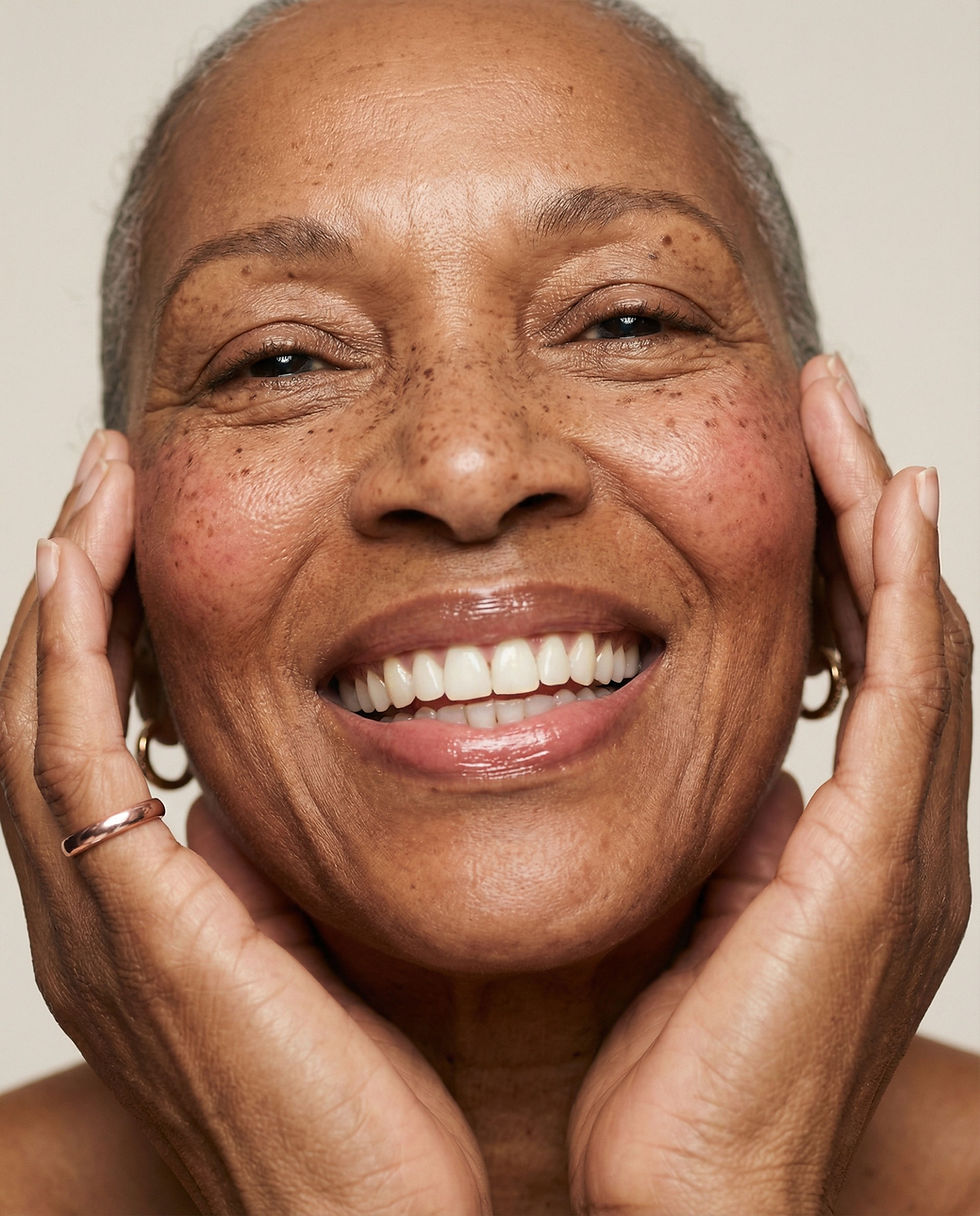
What happens to the skin during perimenopause?
Perimenopause is the transitional stage leading up to menopause. During this time, estrogen and progesterone do not necessarily decline in a smooth, predictable line. They can fluctuate considerably from one cycle to another.
These shifting hormone levels can affect several parts of skin function.
Estrogen helps support skin moisture, collagen, thickness, elasticity and aspects of barrier function. As estrogen becomes less consistent and eventually declines, the skin may become drier, thinner and less resilient. Research has associated estrogen deficiency with reduced hydration, impaired barrier function, collagen loss and changes in wound healing. (PubMed)
For some people, these changes mean that the skin no longer tolerates the same routine it once did.
You might notice:
Increased dryness or tightness
Products suddenly stinging or burning
More visible redness or flushing
Increased itching
Roughness or changes in texture
Slower recovery after exfoliation or professional treatments
Breakouts alongside dryness
Greater sensitivity to heat, weather or fragrance
Fine lines appearing more noticeable as hydration decreases
The American Academy of Dermatology also notes that collagen loss accelerates around menopause, alongside changes in dryness, firmness and skin thickness. (American Academy of Dermatology)
Why can the skin barrier become more vulnerable?
Your skin barrier is the protective layer of the skin. It helps keep water inside while limiting the entry of irritants, allergens and microorganisms into the body.
A commonly thought analogy for this is to think of the skin barrier as a brick wall. The skin cells form the bricks, while lipids (including ceramides, cholesterol and fatty acids) help form the mortar holding everything together.
When hormone changes affect moisture, oil production and skin renewal, that protective wall may not function as efficiently. Water escapes more easily, and substances that were previously well tolerated may begin to feel irritating.
This can create a frustrating cycle:
The skin feels dry or dull.
More exfoliating acids, scrubs or active products are added.
The barrier becomes increasingly overwhelmed.
Redness, burning and sensitivity become more noticeable.
Even more products are introduced in an attempt to fix the reaction.
At Hälsa, this is often where we pause and really assess.
Skin that has become reactive may not need to be pushed harder. It may need fewer variables, more consistency and time to rebuild.
Perimenopause can bring both dryness and breakouts
One of the confusing parts of perimenopausal skin is that it does not always fit neatly into one category. You can experience dryness, sensitivity and adult breakouts at the same time. As estrogen and progesterone fluctuate, androgens can have a more noticeable influence on the skin. This may contribute to changes in sebum production and blemishes, particularly around the chin and jawline.
The instinct is often to reach for stronger acne products. However, repeatedly drying or exfoliating already vulnerable skin may worsen irritation without addressing the complete pattern. Breakouts during perimenopause therefore require nuance. The goal is not simply to remove as much oil as possible. We also need to consider barrier function, inflammation, stress, sleep, blood-sugar patterns, product use and whether the breakout is truly acne or another condition that resembles it.
What do stress and the nervous system have to do with it?
Hormonal changes do not happen separately from the rest of your life.
Perimenopause may also bring disrupted sleep, hot flashes, changes in mood and a different stress response. Hot flashes themselves can involve warmth, sweating and visible flushing. They are experienced by up to 80% of women during the menopause transition. (The Menopause Society)
At the same time, prolonged stress can influence inflammation, scratching, flushing, product tolerance and the way discomfort is experienced.
This does not mean your skin symptoms are “just stress.” The symptoms are real.
It means the skin and nervous system communicate constantly. When hormonal fluctuations, poor sleep, emotional stress and a vulnerable barrier occur together, the threshold at which your skin reacts may become lower.
This is why a calming facial can feel helpful—but it is also why the treatment itself needs to be thoughtfully designed. For reactive skin, more heat, more stimulation and more exfoliation are not always better.
A simpler skincare approach during perimenopause

When the skin becomes unpredictable, the first step is often to simplify rather than add.
In the morning
If you cleansed thoroughly the night before and your skin is dry or reactive, rinsing with lukewarm water may be enough. Follow with a supportive moisturizer and broad-spectrum sunscreen.
Look for ingredients such as:
Ceramides
Glycerin
Hyaluronic acid
Squalane
Peptides
Colloidal oatmeal
Niacinamide, if tolerated
Not every beneficial ingredient is appropriate for every person. A product can be considered gentle and still irritate an individual’s skin.
In the evening
Use a mild, fragrance-conscious cleanser that removes sunscreen and makeup without leaving the skin tight.
Follow with a moisturizer that supports hydration and barrier lipids. If the skin is particularly dry, a more protective cream may be useful.
Be careful with exfoliation
Acids, enzymes, retinoids and manual exfoliants are all forms of exfoliation. Using several of them in the same routine—or using one too frequently—can overwhelm skin that is already struggling to retain moisture.
Retinoids can still be useful for some people during perimenopause, but frequency and formulation matter. They should not be treated as something the skin must “push through” despite persistent burning, cracking or inflammation.
If your skin is actively reactive, restoring comfort may need to come before pursuing rapid correction.
When should you speak with a medical professional?
Not every new rash, breakout or area of redness should be attributed to perimenopause.
Speak with a physician, nurse practitioner or dermatologist if you experience:
A persistent or rapidly worsening rash
Significant swelling, blistering or pain
Open, weeping or infected-looking skin
Severe or persistent itching
Changes around the eyes
A new or changing mole
Symptoms that do not improve when potential irritants are removed
Skin changes accompanied by other concerning symptoms
Conditions such as rosacea, eczema, allergic contact dermatitis, perioral dermatitis and thyroid-related dryness may require medical assessment.
The Hälsa perspective on perimenopausal skin
At Hälsa Fusion in Stratford, Ontario, we do not look at the skin in isolation.
We consider:
Current skin and barrier function
Hormonal and cycle patterns
Stress and nervous-system load
Sleep quality
Digestion and nutrition
Lymphatic movement
Product use and treatment history
The timing and pattern of your symptoms
The goal is not to blame every symptom on hormones. It is to understand what changed, what may be adding pressure to the skin and where support should begin.
Sometimes the first step is changing a product.
Sometimes it is reducing stimulation.
Sometimes it is supporting sleep, nourishment and regulation while the barrier rebuilds.
>> Your symptoms make sense when we look at the whole picture.
If your skin has become more sensitive, dry, flushed or unpredictable during perimenopause, the Hälsa Fusion Whole Body Assessment offers space to explore the pattern and create a more personalized path forward.


Comments